
 EN
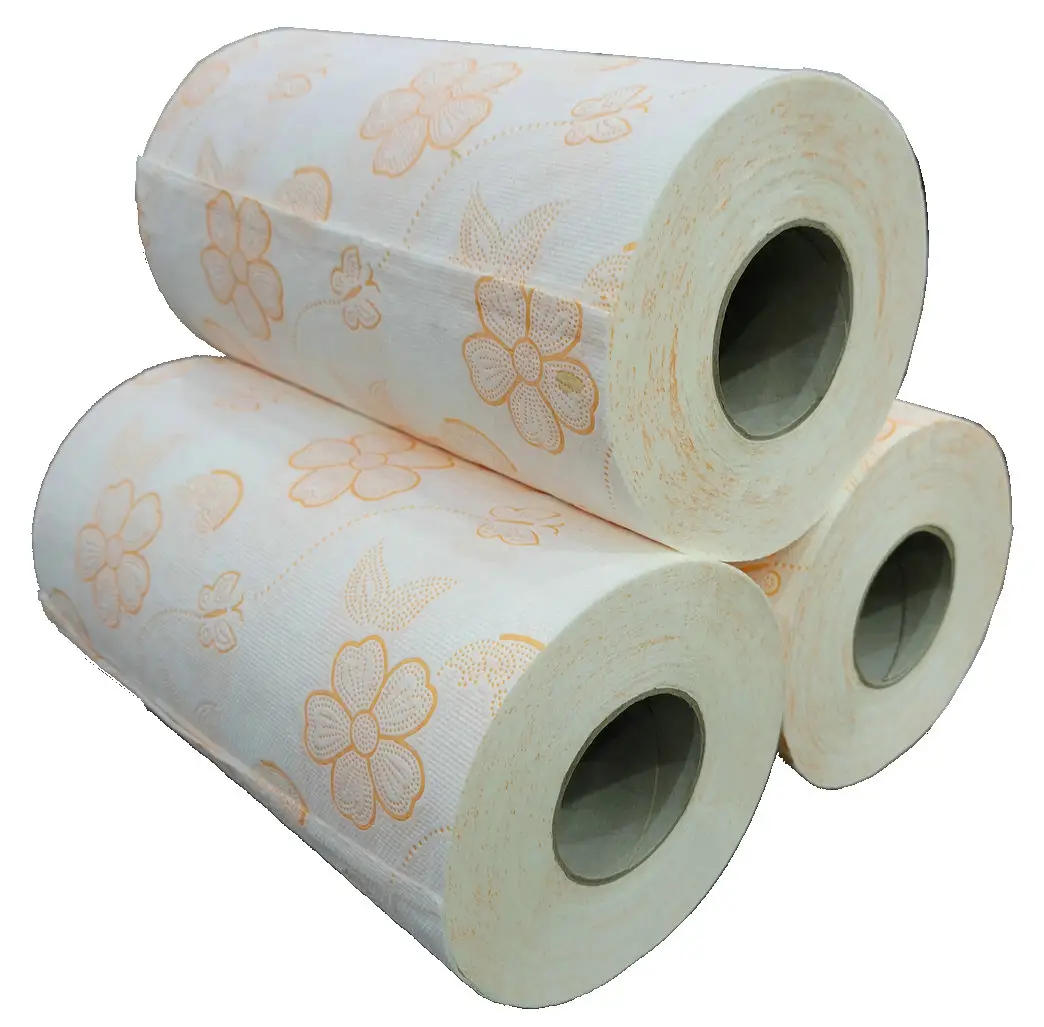
The Science Behind Double-Layer Strength: Fiber Entanglement and Stress Distribution
Mechanism: Interlayer fiber entanglement resists tensile failure under wet load
A double-layer kitchen towel gains its strength not from glue—but from mechanical fiber entanglement. A precision kitchen towel processing machine uses controlled pressure and embossing to force fibers from each ply into the opposing layer, creating a 3D interlocked network. In dry conditions, hydrogen bonds between cellulose molecules provide initial integrity. When wet, those bonds break—but the physical entanglement remains. These twisted, overlapping fibers act as micro-knots, dissipating energy through friction and controlled slippage under tensile stress. Crucially, the entangled interface impedes crack propagation: tearing requires pulling fibers loose from an interpenetrated structure—a high-energy process. Even during repeated scrubbing, this architecture resists delamination and preserves load-bearing capacity. The result is a towel that retains a high portion of its dry tensile strength—preventing finger-poke ruptures or edge tears during heavy-duty wet cleaning. This explains why properly engineered double-layer towels consistently outperform single-ply versions in standardized wet-strength retention tests.
Physics insight: How layered architecture redistributes localized stress across two planes
A single-ply towel concentrates all stress at a flaw tip—making rapid crack growth inevitable. The double-layer design introduces a second, interconnected plane that shares and redistributes that load. When a crack initiates in one layer, fiber bridges across the entangled interface transfer part of the stress to the adjacent layer—reducing crack-tip stress intensity and effectively blunting the fracture. The architecture functions like a redundant system: if one layer begins to yield, the other continues to carry significant load, delaying complete rupture. Interlayer shear within the entangled zone further absorbs strain—mirroring toughening mechanisms seen in laminated composites. Because modern kitchen towel processing machines ensure uniform entanglement density, this load redistribution occurs consistently across the sheet. Practically, it means double-layer towels withstand twisting, pulling, and point loads—like wiping a rough surface with a saturated towel—far more reliably than single-layer equivalents. This stress-relieving effect directly underpins measurable improvements in burst strength, tear propagation resistance, and overall durability per TAPPI T494.
Wet Strength Retention: Why Dual-Layer Design Outperforms Single-Layer in Real-Use Conditions
Data-driven trend: Commercial demand for ≥75% wet-to-dry strength retention (TAPPI T494, 2023)
Commercial kitchens and high-traffic facilities now treat wet strength as a non-negotiable performance indicator. Standard single-layer towels often retain less than 50% of their dry strength when saturated—leading to frequent tearing during vigorous wiping. In contrast, engineered double-layer constructions routinely exceed the ≥75% wet-to-dry retention threshold established by TAPPI T494 (2023). This benchmark reflects real-world needs: a 2022 survey of large-scale food service operators found that 68% had switched to dual-layer towels specifically to reduce failures during deep cleaning. The dual-layer architecture keeps both plies structurally engaged—even when fully saturated—preventing the catastrophic sheet separation common in lower-grade single-ply products. Meeting the 75% threshold also correlates with lower towel consumption, as staff discard fewer units prematurely. For procurement teams, the TAPPI value serves as a transparent, verifiable metric distinguishing durability-engineered products from commodity alternatives.
Material synergy: Cellulose cross-linking + dual-layer lamination for sustained wet toughness
Sustained wet toughness emerges from the synergy of chemistry and structure. Cellulose cross-linking additives form covalent bonds between adjacent fiber chains—reinforcing the hydrogen-bonded network that normally degrades in water. Yet chemical resilience alone is insufficient without structural support. Dual-layer lamination creates a mechanical interlock between two fiber mats, doubling fiber-to-fiber contact points and adding a secondary plane of stress resistance. When a wet towel is twisted or stretched, the laminated layers resist delamination—and the cross-linked fibers within each ply maintain their integrity. The result is a sheet that can be wrung repeatedly without losing cohesion. Modern kitchen towel processing machines enable this synergy via synchronized dual-head forming and precision nip-pressure control—ensuring uniform application of cross-linking agents and seamless layer bonding. The outcome is a towel that approaches its dry tensile performance even after prolonged saturation—the kind of reliable wet toughness commercial kitchens depend on daily.
Weave Architecture vs. Layer Integration: Why 3D Structural Cohesion Matters More Than Tightness Alone
Critical flaw: Tighter 2D weave fails under shear when interlayer adhesion is weak
A denser 2D weave may appear stronger—but without genuine interlayer bonding, it becomes a liability under real-world use. Twisting, wringing, or scrubbing generates shear forces parallel to the sheet plane. If layers rely only on surface friction or weak adhesive, the interface slips and delaminates long before the fibers themselves fail. By contrast, a truly integrated 3D structure—achieved through advanced creping and lamination techniques—distributes shear stress across both layers simultaneously. This engineered cohesion prevents catastrophic separation and ensures structural integrity, even when wet. Tightening the weave alone cannot compensate for poor interlayer adhesion: mechanical integration—not just fiber density—is what delivers functional strength.
Kitchen Towel Processing Machine Innovations Enabling Reliable Double-Layer Formation
Precision adaptation: Dual-head creping with real-time nip pressure synchronization
Advanced kitchen towel processing machines incorporate dual-head creping units designed to maximize fiber-to-fiber bonding across both layers. Unlike legacy single-creping systems, these configurations synchronize nip pressure between heads in real time—automatically adjusting for variations in base sheet moisture, caliper, and machine speed. A closed-loop system uses embedded piezoelectric sensors to detect pressure deviations as small as 0.1 kPa, triggering immediate compensatory action. This dynamic control prevents layer delamination and microscopic voids that compromise structural integrity under load. Uniform pressure profiles ensure identical mechanical treatment of each layer—delivering consistent entanglement density and elevated wet tensile strength.
Quality control integration: In-line thickness and layer-adhesion monitoring for consistency
In-line monitoring of thickness and layer adhesion guarantees every double-layer towel meets specification. Optical and laser-based sensors measure caliper to micron-level resolution, while capacitive probes assess interlayer adhesion strength immediately after lamination. Real-time data feeds directly to the control panel—flagging deviations and enabling parameter adjustments without halting production. This integration eliminates post-production sampling delays, ensures consistent quality across entire rolls, and reduces customer complaints and material waste.
FAQs
What is the main advantage of double-layer kitchen towels?
Double-layer kitchen towels offer superior wet strength retention, durability, and resistance to tearing, especially during heavy-duty cleaning, thanks to their fiber entanglement and stress distribution features.
How does fiber entanglement enhance wet strength?
Fiber entanglement creates a 3D interlocked network between the layers, distributing stress and preventing crack propagation, even under wet or high-stress conditions.
Why do double-layer towels outperform single-layer towels?
Double-layer towels are designed with interconnected layers that redistribute stress and resist delamination, whereas single-layer towels concentrate stress at a single point, leading to rapid tearing during use.
What does the TAPPI T494 standard measure?
TAPPI T494 measures the wet-to-dry strength retention of towels, indicating their durability and resistance to tearing when wet.
What innovations in processing machines support double-layer towel production?
Modern machines use dual-head creping, real-time nip pressure synchronization, and in-line monitoring systems to ensure uniform fiber entanglement, layer adhesion, and consistent quality.
Table of Contents
- The Science Behind Double-Layer Strength: Fiber Entanglement and Stress Distribution
- Wet Strength Retention: Why Dual-Layer Design Outperforms Single-Layer in Real-Use Conditions
- Weave Architecture vs. Layer Integration: Why 3D Structural Cohesion Matters More Than Tightness Alone
- Kitchen Towel Processing Machine Innovations Enabling Reliable Double-Layer Formation
- FAQs
